
 TEACHING AIDS
 Laboratories of the Future – Polish project
 Active Board – Polish project
 INVESTMENTS IN EDUCATION
 Learning in Ukrainian / Навчання українською мовою
 Physics for students from Ukraine / Фізика
 Chemistry for students from Ukraine / Хімія
 Biology for Ukrainian students / Біологія
 Mathematics for students from Ukraine / Математика
 Geography for Ukrainian students / Географія
 Polish language for students from Ukraine / Польська
 ACTION-INTEGRATION / ОПЕРАЦІЯ – ІНТЕГРАЦІЯ
 School Labs for: Physics - Biology - Geography - Chemistry
 Environmental Education
 Water, Soil, Air - Learning and Testing
 Microscopes, Slides, Optical instruments
 Biology
 Health Education
 Weather
 Geography, Earth Sciences
 Astronomy
 Physics
 Balances and Laboratory Equipment
 Chemistry
 Mathematics
 Interfaces and measuring sensors
 Digital School
 Educational Robots
 Coding
 Technology and Design
 School Experiments
 History
 Polish language
 Foreign languages
 Artistic Education / Art
 Pre-primary and early childhood education
 Personalized Learning
 Other equipment
 Physical Education (P.E.)
 Natural Sciences Laboratories
 Music
Music Social education
 Road Safety Education (RSE)
 Green Labs
 ECOLOGY: EDUCATION and RESEARCH
 Environmental Science Lab (EcoLab)
 Forest education / Trip to the forest
 Exploring Water, Soil, Air
 Waste, recycling, biodegradation
 Clean energy / environmental protection
 Collection and fishing of specimens
 Microscopes, cameras, slides
 Other optical instruments
 Measuring instruments
 Field and optical instruments
 Weather / Weather conditions
 Natural specimens
 Test kits
 Earth science
 Models, demonstration aids
 Plates, maps, globes, folios
 Astronomy
 Multimedia (movies, programs, audio CD)
 Genetics / Cell
 Human biology
 Weights
 Laboratory equipment
 Equipment
 Young Naturefriend
 CHILDREN & FAMILIES, HOBBIES
 From Earth to the stars
 Natural research and observation
 Let's save our planet!
 Finger after finger
 The multimedia world of education
 21st century energy
 Magnetism, that is, let us attract ourselves
 The laws of physics and nature
 We measure and weigh
 Home Laboratory
 Mathematics - not as terrible as they paint it
 Large and small constructions
 Let's go!
 Young artists
 Foreign languages otherwise
 History and (Pre)history
 We take care of our health
 Collectors and enthusiasts
 Games and plays
MACHINE TRANSLATION (not authorised yet)
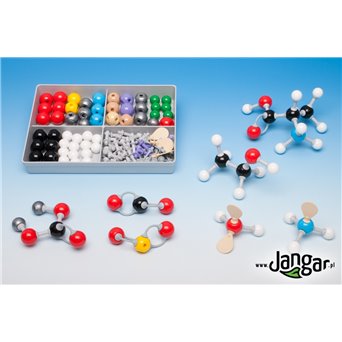
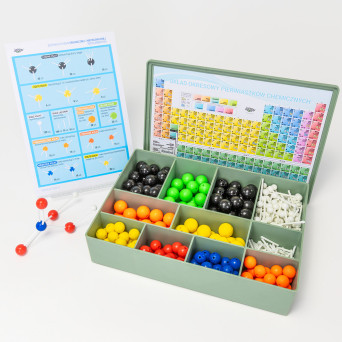
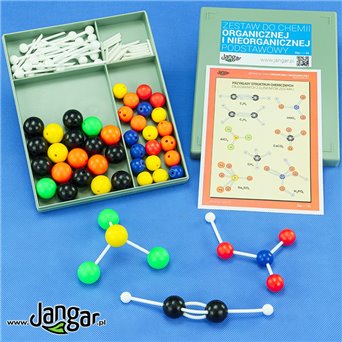
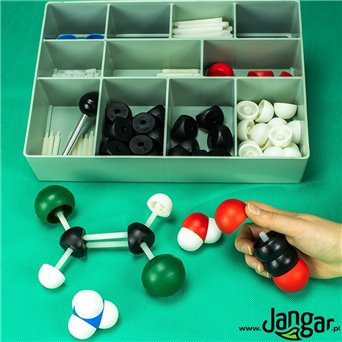
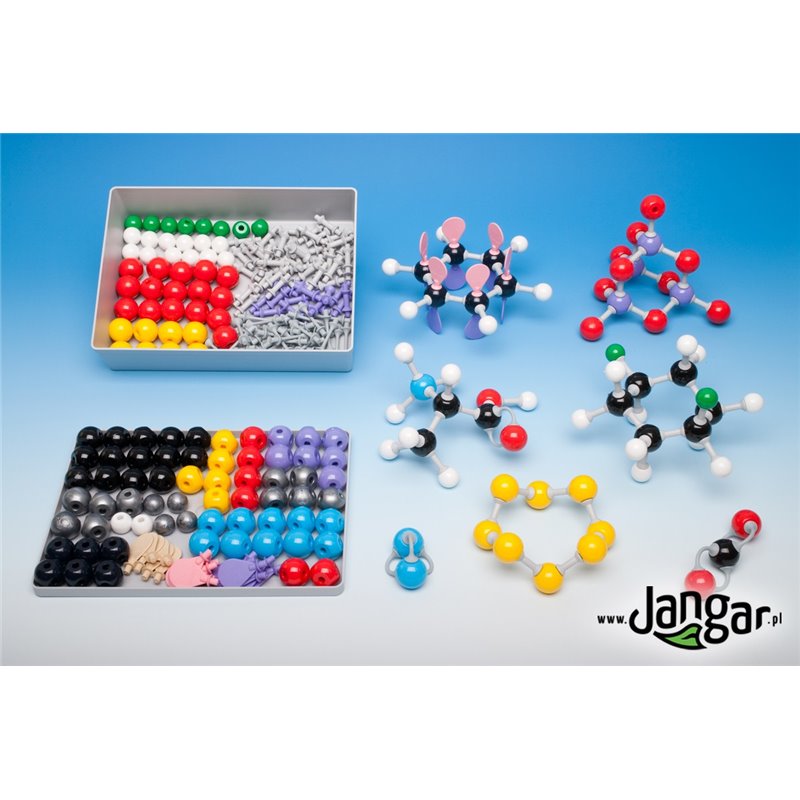
The set contains 212 elements made of coloured plastic (earlier version: 192 elements) to build a very wide range of chemical structures. The set includes models of such elements as carbon, hydrogen, nitrogen, oxygen, sulphur, phosphorus, halogens and metals - each element is represented by 1-5 types of models; e.g. phosphorus is represented by three ball models with 4, 5 and 3 holes and angles 109, 90 and 120 and 107 respectively. Bindings (e.g. single covalent, double, triple, coordination and ionic) are symbolized by 3 types of fasteners. Additional elements are 3 types of pear-shaped leaves (18 pieces in total), which may represent single electron pairs occurring in water and ammonia or characteristic bonds occurring in ethylene and benzene.
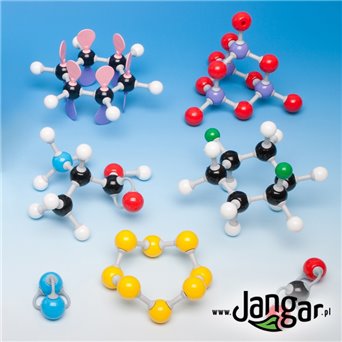
The elements of the set can be used to build, among others: molecules (e.g. hydrogen, chlorine, oxygen, ozone, nitrogen, phosphorus, sulphur, carbon - different allotropic varieties), hydrides (e.g. hydrogen chloride, chlorine, oxygen, ozone, nitrogen, phosphorus, sulphur, carbon - different allotropic varieties), hydrides (e.g. hydrogen chloride, chlorine, oxygen, ozone, nitrogen, phosphorus, carbon - different allotropic varieties). Hydrides (e.g. sodium, magnesium, silicon and hydrogen chloride, ammonia, methane, water, hydrogen sulphide), chlorides and fluorides, metal oxides, non-metallic oxides, acids, metal ions, organic compounds (e.g. benzene, glycerol, ethane, ethylene, ethanol, etc.). The structures built are large and, more importantly, clear and transparent.
You might also like